Robotic Fluids for artificial muscles, wearable cooling, and active textiles Principal Investigator: Prof. Vito Cacucciolo · Politecnico di Bari
€1.5 M
EU contribution, ERC Starting Grant
5 years
January 2024 – December 2028
Poliba
host institution, Politecnico di Bari
The idea
Fluid circulation is everywhere in living creatures and in machines, and it serves many functions at once: temperature regulation, transport of nutrients, mechanical actuation. A beating heart is a soft pump that keeps an animal alive.
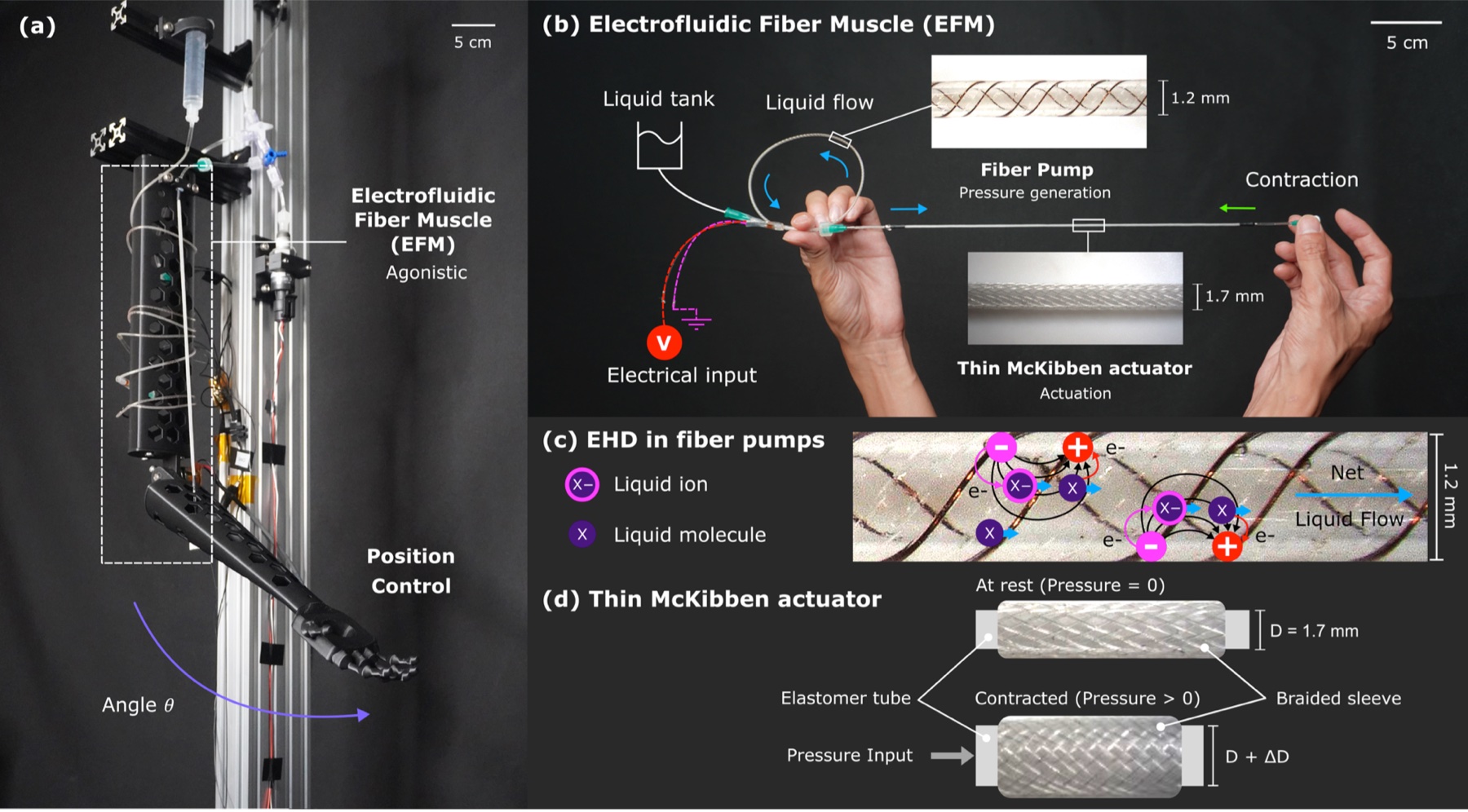
RoboFluid merges the capabilities of fluids with electrical control, to give robots and wearables the same advantages. Conventional fluidics needs many components — pumps, valves, tubing, plugs — and this has kept it out of untethered systems. RoboFluid replaces them with solid-state pumps in which the fluid is accelerated directly by electric fields (electrohydrodynamics, EHD), creating a new class of fluidic devices where flow is driven in situ by electrical signals, and where velocity, pressure and temperature of the fluid sense the state of the device and of its environment.
On the scientific side, the project studies fluid mechanics and field emission in liquids under intense electric fields — the physics that sets how much pressure, flow and power these pumps can deliver.
The project builds on two pumps developed at EPFL-LMTS: the stretchable pump, a soft pump with no moving parts, and the fiber pump, which generates pressure along its own length and can be woven into textiles. Woven into a garment, fiber pumps already circulate a fluid that heats or cools the wearer, with no external pump: the starting point for the wearable coolers of RoboFluid.
Robust, high-power-density fluidic muscles that make low-cost dexterous robotic hands possible.
/02
Wearable coolers
Cooling garments that reduce the energy spent on air conditioning and protect fragile people during extreme heat waves.
/03
Active textiles
Textile artificial muscles that facilitate daily actions for the elderly and enable remote physical interactions.
Research lines
/01
Fluidic artificial muscles
Electrically driven fiber actuators — modular and scalable — for robots that move like living bodies.
/02
Haptic gloves
Wearable tactile feedback for telemanipulation: working with your hands thousands of kilometres away.
/03
Thermoregulating clothing
Fluidic circuits woven into garments that actively heat or cool the wearer.
/04
Low-cost robotic hands
Prosthetics and end-effectors driven by muscle fibers, with the linear configuration of natural muscle.
Results
Science Robotics · 2026
Electrofluidic fiber muscles
O. Kilic Afsar, G. Pupillo, G. Vitucci, W. Babatain, H. Ishii, V. Cacucciolo — with the MIT Media Lab
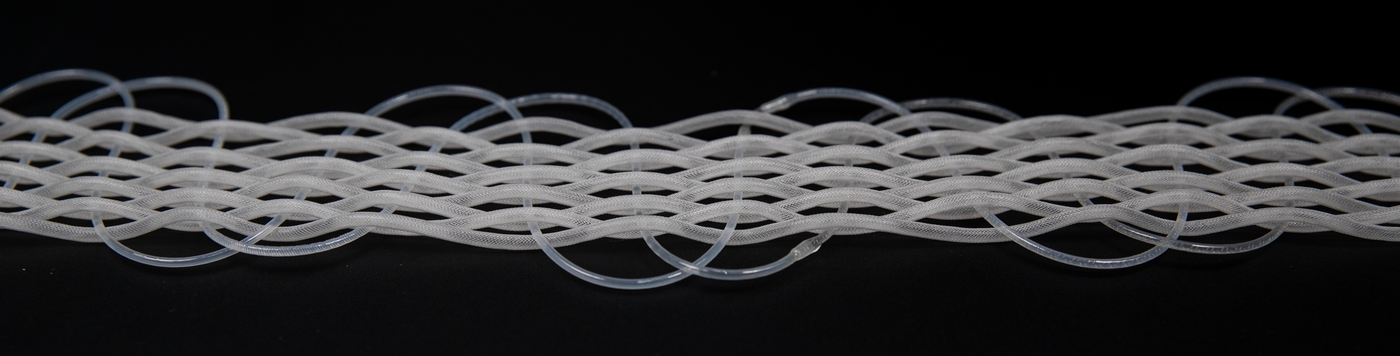
A new class of artificial muscles in fiber format. Each muscle integrates fiber EHD pumps and thin McKibben actuators in a closed fluidic circuit: electric, silent and untethered, with no external compressors or tubes. Thanks to bias pressure, the modular muscles reach a power density comparable to that of skeletal muscle, and woven in antagonistic pairs they move like biceps and triceps.
Electrofluidic fiber muscles with closed-loop control
A. Castellaneta, Y. Kuwajima, V. Cacucciolo
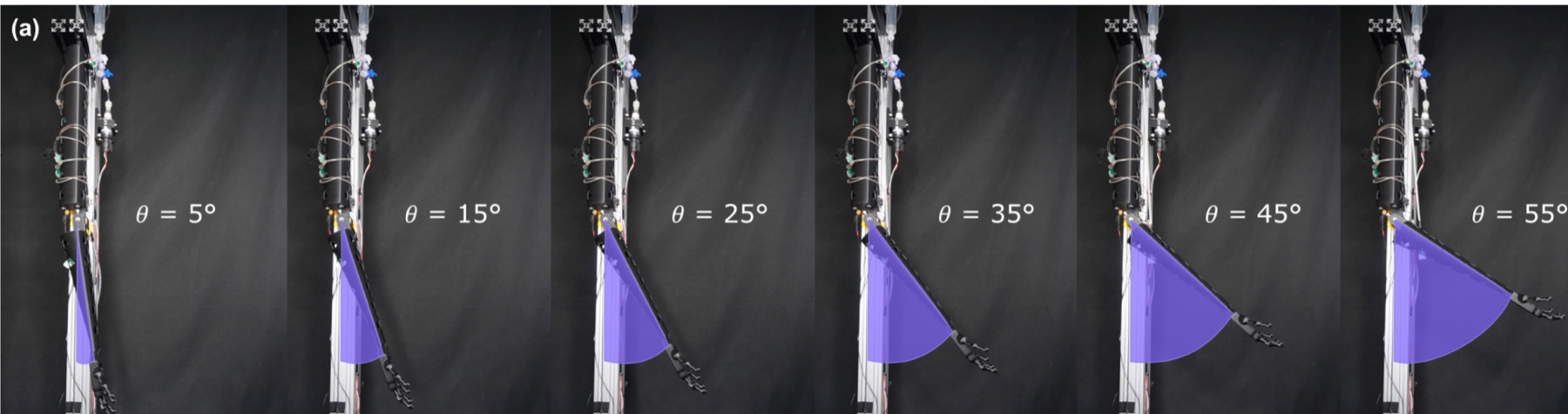
For wearable and assistive robotics, power density is not enough: the muscle must also be controllable. A single electrofluidic fiber muscle, mounted like a biceps, drives a 70 g robotic forearm through an elbow range of 5° to 75°. A hybrid controller — a PID loop plus a quasi-static inverse model identified from experiments — sets the joint angle by modulating the voltage on the fiber pumps.
In closed loop the arm reaches each target with an average rise time of 0.44 s, a settling time of 2.44 s and a mean steady-state error of 0.2°, and the hysteresis of the muscle drops by about 93% compared with open-loop operation.
O. Kilic Afsar, G. Pupillo, G. Vitucci, W. Babatain, H. Ishii, V. Cacucciolo.Electrofluidic fiber muscles.Science Robotics 11 (2026)Learn moreOpen accessDOI
A. Castellaneta, Y. Kuwajima, V. Cacucciolo.Electrofluidic fiber muscles with closed-loop control.IEEE Robotics and Automation Letters 11, 11007–11014 (2026)Open accessDOI
D. De Tommasi, F. Trentadue, G. Vitucci.A compact anisotropic model for the mechanical response of double network hydrogels.International Journal of Engineering Science 220, 104437 (2026)DOI