

The problem
Muscles are extraordinarily effective systems for generating controlled force, and engineering has struggled for decades to match their combination of power, speed, scalability and control. Fluidic actuators come close, but depend on heavy, noisy external hydraulic infrastructure. And the electric motors of today's robots produce rotation on a shaft — a configuration fundamentally different from the linear contraction of natural muscle.
The innovation

The electrofluidic fiber muscles (EFM) close the loop on the two earlier research lines: the charge-injection fiber pumps are integrated directly into the muscle system, in a closed fluidic circuit with thin McKibben actuators. A millimetre-scale pump sits between two actuators, pushing fluid into one to contract it while the other relaxes. The result is an electric, silent and untethered muscle: no external pumps, compressors or tubes.
Like real muscle
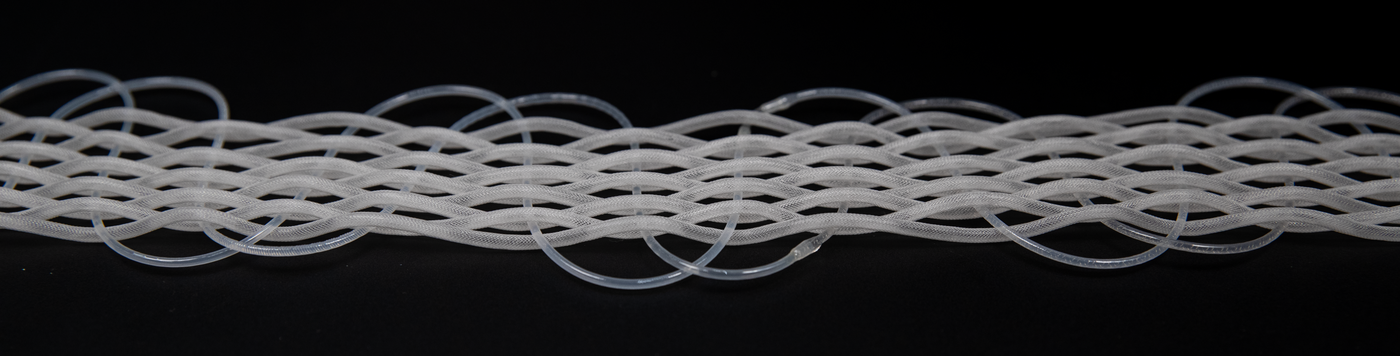
Like the fibers that bundle together in biological muscle, the EFMs combine in different configurations depending on the task. A key finding is the role of bias pressure: by pre-pressurising the circuit, the modular muscles reach a power density comparable to that of skeletal muscle. Each fiber weighs a few grams and is not much thicker than a toothpick; woven together, they form flat muscle pairs that can be integrated into textiles.
The applications
The fiber format is particularly suited to wearable applications: exosuits that assist load lifting, devices that restore or augment the dexterity of the hand, prosthetics with the linear configuration of natural muscle. But the principles extend to fluidic robotic systems in general — from soft manipulation to robots that collaborate safely with people.