

The principle
Electroadhesion grippers hold objects with electrostatic forces. A thin, soft membrane carries interdigitated electrodes: when a voltage is applied, the electric field reaches into the object and pulls the membrane onto its surface. Because the membrane is soft, it conforms to the object at the scale of its roughness, and the adhesion is switched on and off by an electrical signal.
The result is a gripper that grasps without squeezing — from cherry tomatoes to jars — silently, with low power and no vacuum infrastructure. Making it practical required understanding the contact mechanics behind it: how adhesion depends on the peeling angle, how fingers zip onto curved objects, and how a membrane can combine electroadhesion with suction.
Results
Electroadhesion suction cups
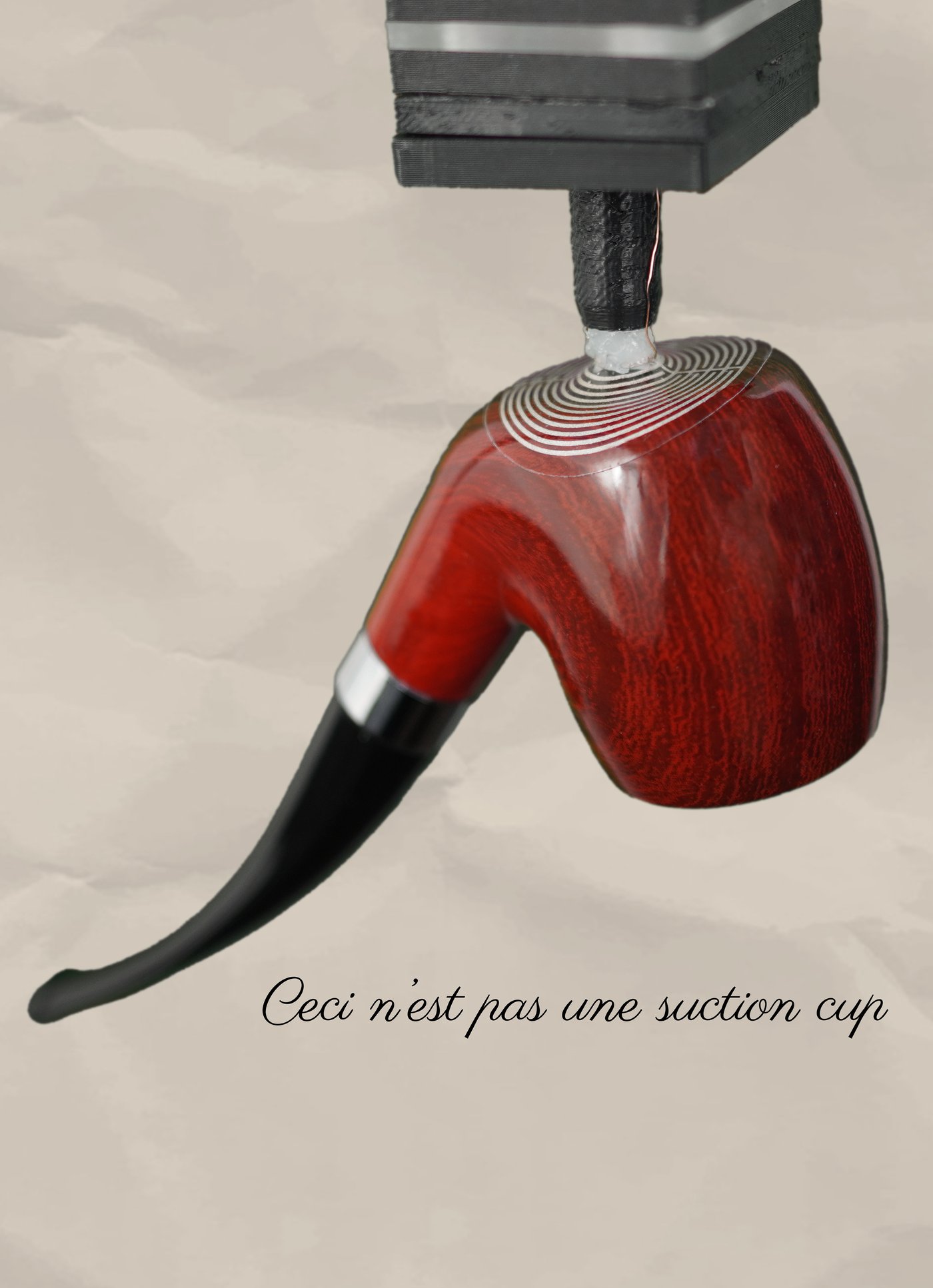
Suction cups are the light bulbs of robotics: simple and reliable, but energy-hungry and dependent on a bulky, noisy vacuum infrastructure. Electroadhesion suction cups are soft, silent, monolithic and fully electric. The membrane zips onto the object, and as it stretches during lifting it forms a passive vacuum inside its conical chamber. With a power consumption of only 1.5 W they grasp flat and curved objects, smooth or rough, holding payloads up to 1.5 kg.
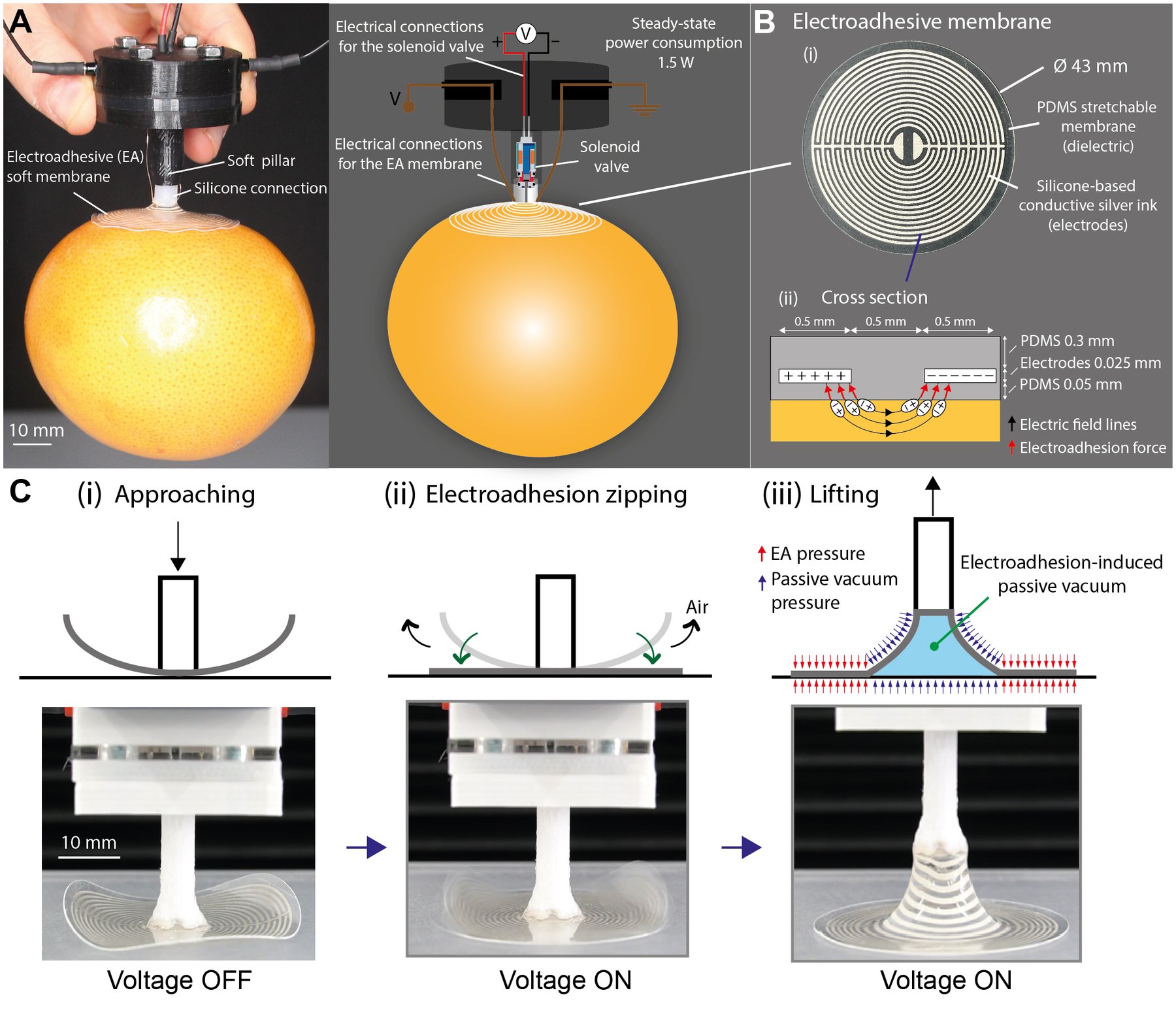
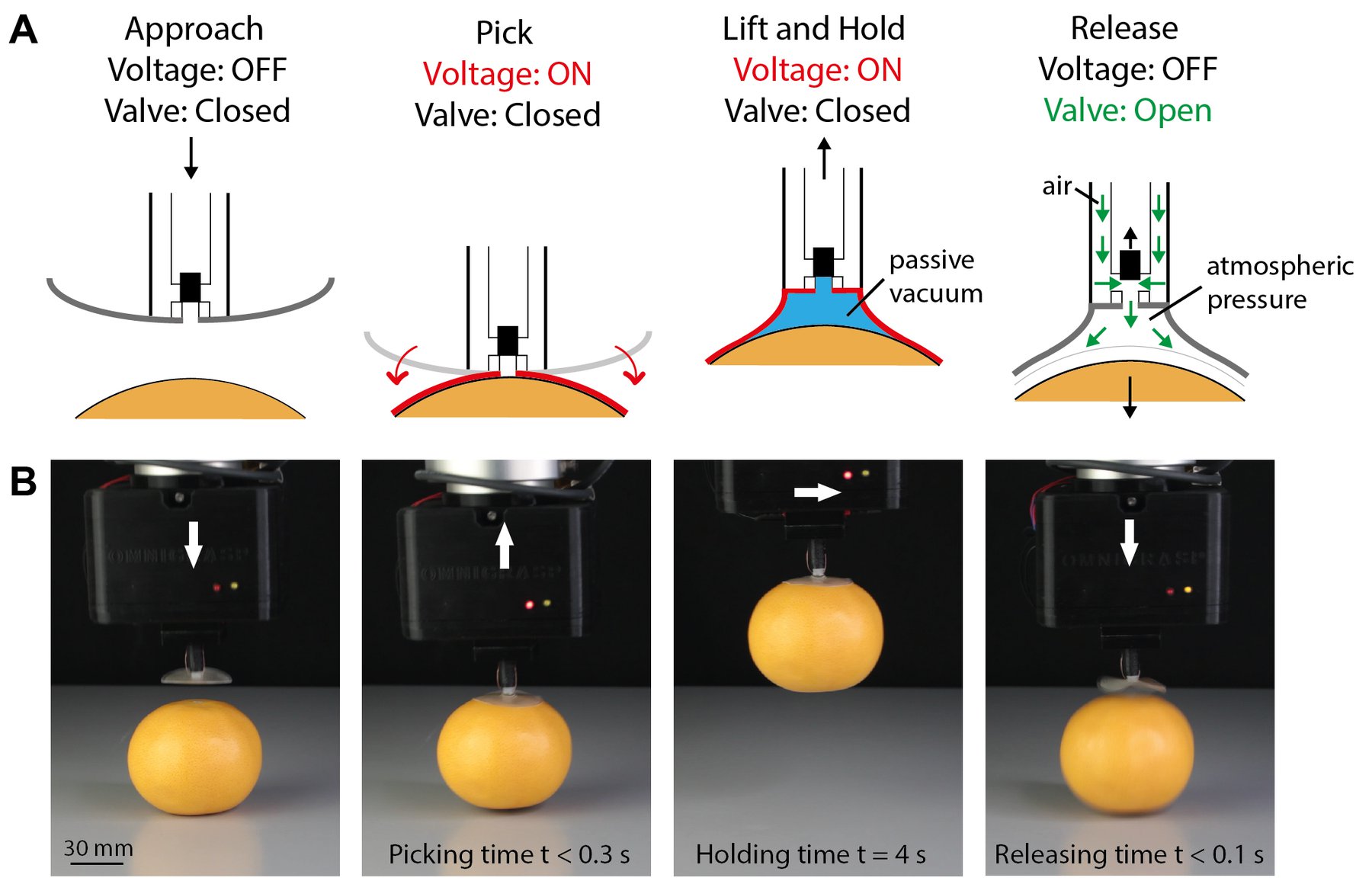
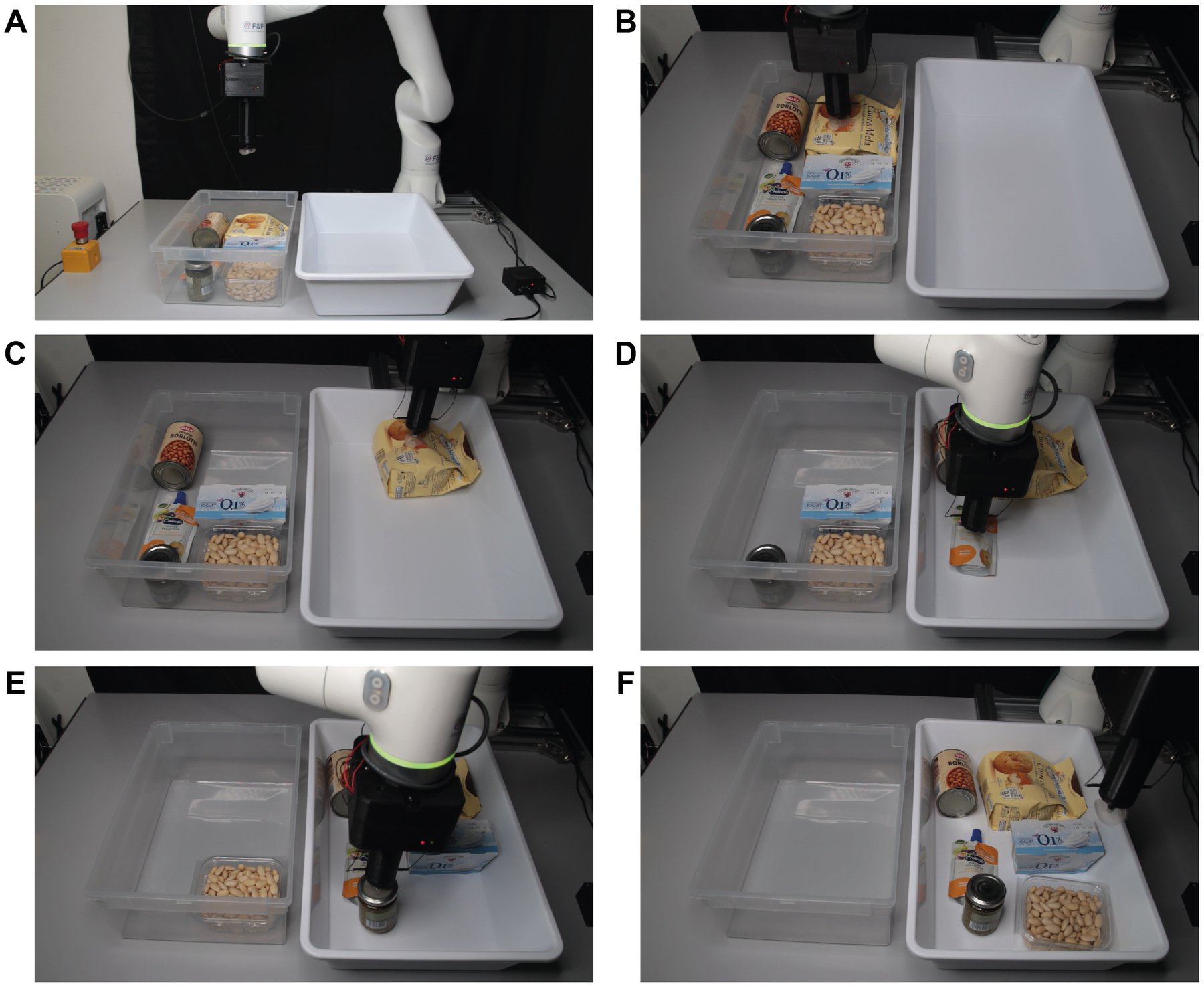
Turning the voltage off and opening a small valve lets air back into the chamber: the object is released in a fraction of a second. Mounted on a robot arm, the suction cups pick fruit, soft pouches, jars and packaged food.
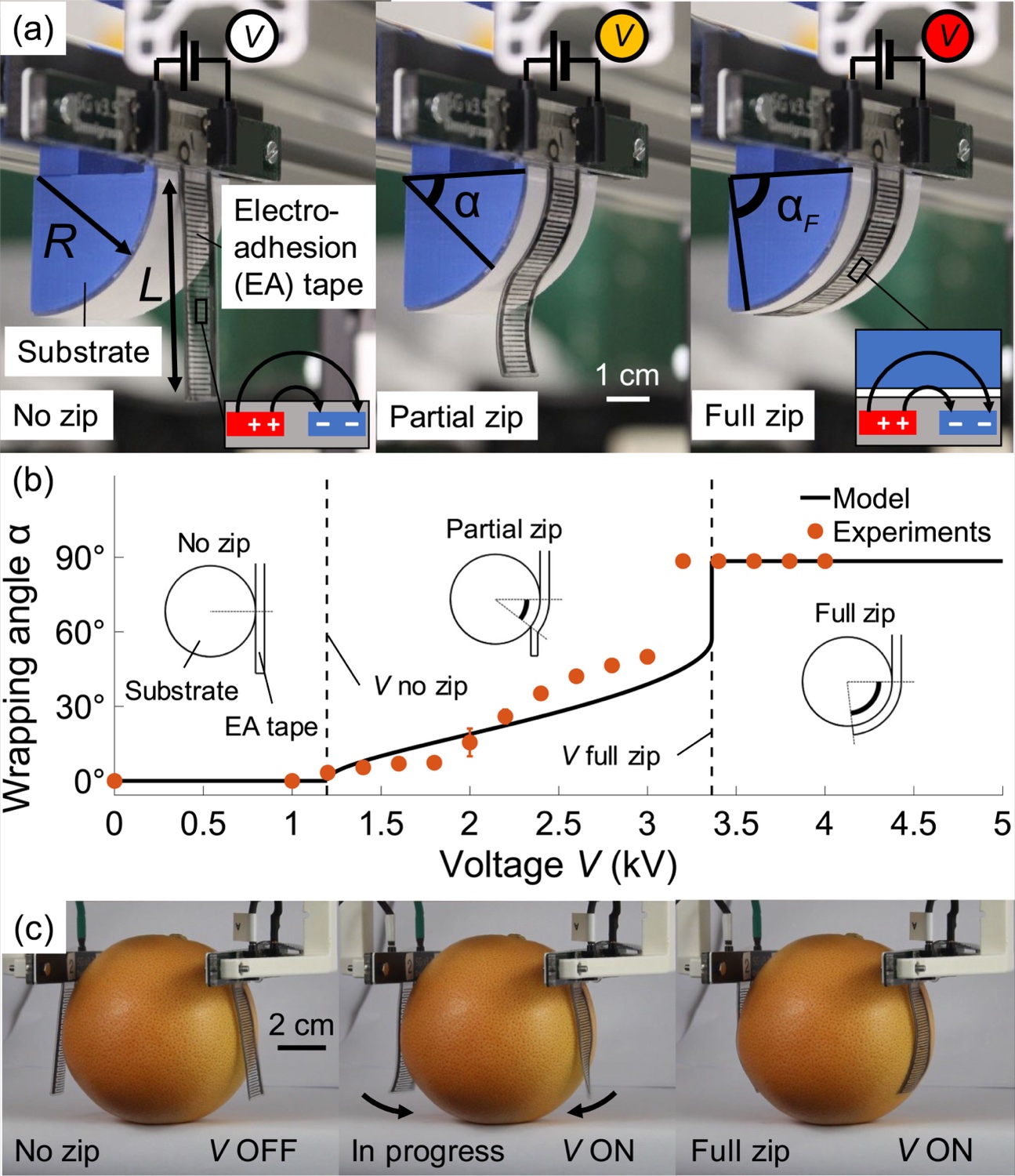
Electroadhesion zipping with soft grippers on curved objects
Adding actuators to close soft fingers stiffens them, and stiffer fingers conform less and adhere less. With the right materials and geometry, electroadhesion alone can drive a soft finger to zip around an object. The phenomenon is governed by two voltage thresholds — one below which nothing happens, one above which the finger fully collapses on the object — and, unlike electroadhesion forces, scales with V²/d rather than V²/d². Thin fingers wrap objects of different materials with angles up to 90°, pointing to grippers that lift objects more than 1000 times their own weight.
Peeling in electroadhesion soft grippers
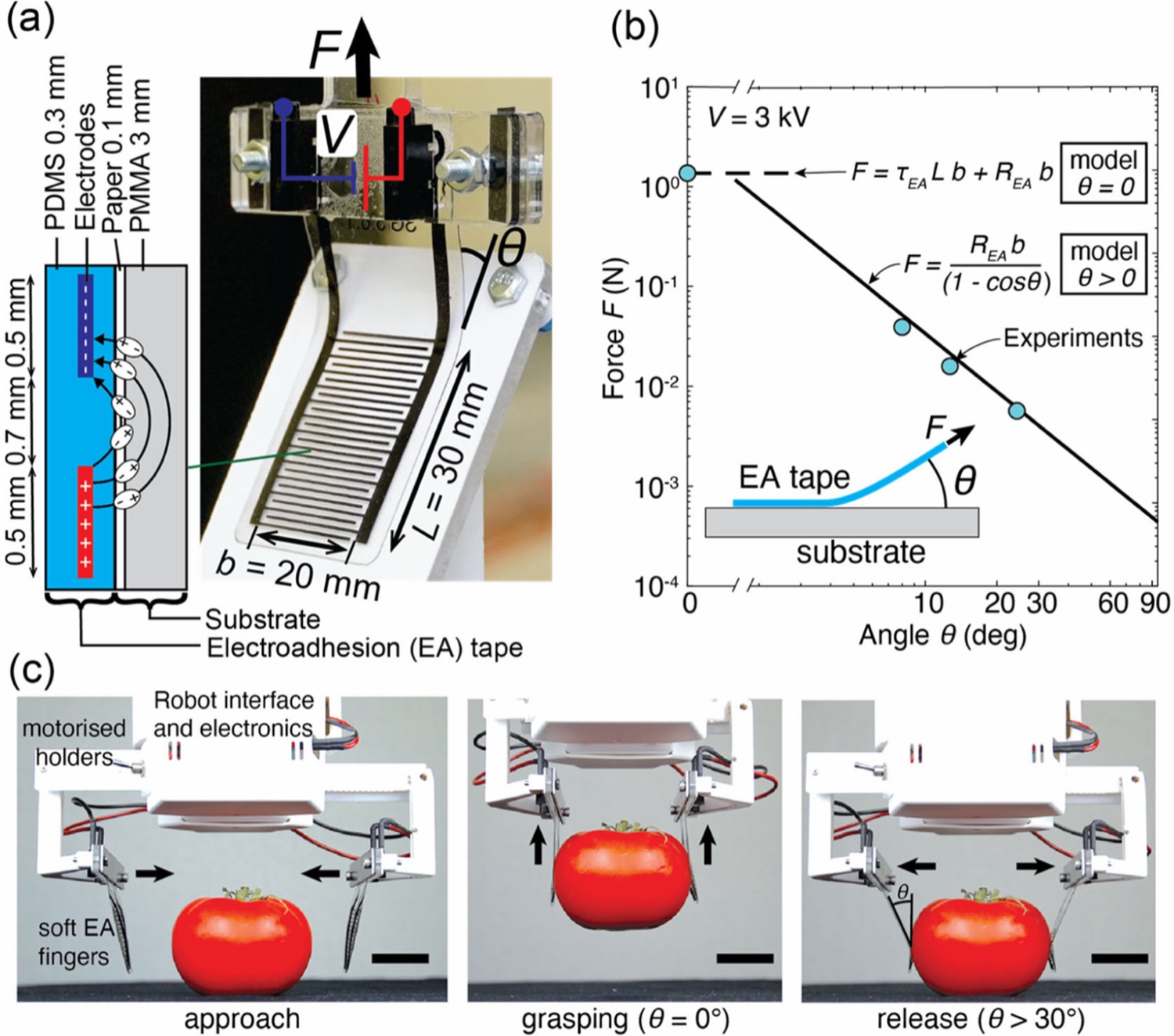
Two problems held electroadhesion back: the adhesion force can vary more than 1000 times with the angle between tape and object, and release is slow because of residual adhesion. Simple peeling models predict a force from under 1 mN to over 1 N as the angle goes from 90° to 0°. A gripper with motorized fingers puts this to use: it grasps at 0°, picking up anything from a 10 g cherry tomato to a 600 g mango, and releases at more than 30°, reliably and in under 300 ms.
Project HARTU (2023–2025)
HARTU — Handling with AI-enhanced Robotic Technologies for flexible manufacturing — was an industry-driven Horizon Europe project on the three stages of handling parts: grasping, assembly and release. One of its four technical goals was to develop versatile and dexterous soft grippers with electroactive fingertips, the contribution of Politecnico di Bari and OmniGrasp. The technologies were deployed in five industrial scenarios: four manufacturing lines — automotive, household appliances, hand tools and food processing — and one in logistics. Electroadhesion suction cups and electroadhesion zipping are among the project's published results.
Spin-off: OmniGrasp
OmniGrasp, the laboratory's spin-off, creates electroactive soft robots to solve automation with difficult objects: food, textiles and biomedical products. Building on the results of HARTU, where the electroadhesion technology was demonstrated at TRL 4, OmniGrasp is now taking electroadhesion suction cups to industrial pilots in packaging, automotive assembly and logistics with the EIC Transition project EASIERGrasp (2026–2029).
Team
 Vito CacuccioloPrincipal Investigator
 Fabio CarusoCEO, OmniGrasp
 Simone De CarolisAssistant Professor / RTDA
 Fabio GarganoHead of Mechatronics, OmniGrasp
 Antonio CamposeoHead of Software & AI, OmniGrasp
 Angelo CatalanoPhD Student
Publications
- F. Caruso, H. Shea, V. Cacucciolo. Electroadhesion suction cups. Advanced Materials 37, 2420231 (2025)Open access
- M. Mastrangelo, F. Caruso, G. Carbone, V. Cacucciolo. Electroadhesion zipping with soft grippers on curved objects. Extreme Mechanics Letters 61, 101999 (2023)Open access
- M. Mastrangelo, V. Cacucciolo. High-force soft grippers with electroadhesion on curved objects. IEEE 5th International Conference on Soft Robotics (RoboSoft) (2022)DOI
- V. Cacucciolo, H. Shea, G. Carbone. Peeling in electroadhesion soft grippers. Extreme Mechanics Letters 50, 101529 (2022)Open access